
Since becoming an accredited coach at the end of 2022, I’ve been part of a community and membership called the Consciously Connected Coaching Collective.
It’s run by Claire Bradshaw who I did my ILM Level 5 and Level 7 training with, and each month we have a workshop on a different area of coaching.
There are also drop in calls where we can come along and talk about our work, ask questions and support one another.
Claire runs in-person events where we get to meet up with fellow coaches, and the one for September 2026 was themed around Conscious Connection.
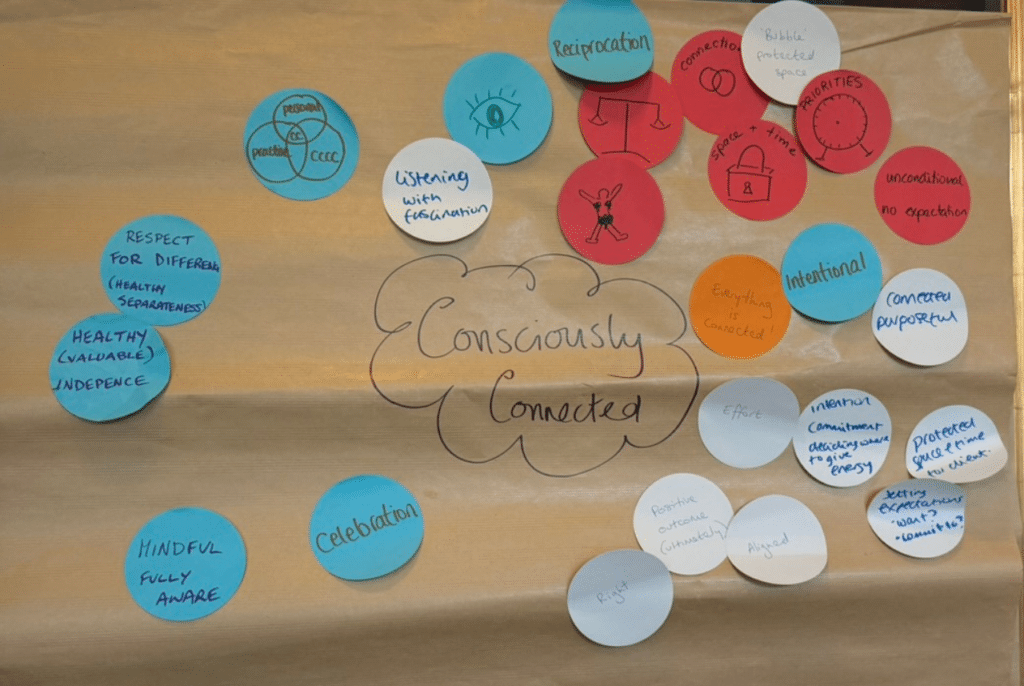
We had lots of discussions about what Conscious Connection means, and the question I explored with another coach, Kate, was this.
‘What difference does Conscious Connection make to coaching outcomes?’
As is often the case when you’ve been to an event like this, I came away with my head buzzing with thoughts about connection in my own work.
This post explores the relationship between connection and coaching outcomes.

What does connection mean?
Claire provided definitions in quotes around the room, and one was this from Brene Brown.
“Connection is the energy that exists when people feel seen, heard, and valued.”
I had a discussion with another coach, Cathy, about what connection means as part of a community and in coaching itself.
For the community, and I’m sharing this as it’s relevant, as I have my own community, The Planner Club, these were some of the things that came up.
How connection works in community
Being committed to being part of the community.
Making that pledge to give your energy to it and make time to be part of it.
Making the effort to contribute to the community.
Having an intention for joining in the first place – I’m clear about what my community is for in The Planner Club – so people join with the intention to work on their planning.
Giving back – so reciprocity is important – you take and you give back and are inspired and inspire.
Capacity is important too – I want members to have the time to make the most of being in the community.
And finally, celebration. This is such a HUGE part of my communities, celebrating their work because many work alone and don’t have anyone to celebrate with.
One thing I notice is the people who come to the Zoom calls and have their camera on, who ask for help, who chat, who keep coming back, who support others, who use the community when they’re stuck, and when they want to celebrate, are the ones who get the most from it.
By that I mean they make sales, they get braver, they find people who can help them grow, and so much more. It’s not just about engagement.
This is not me saying you are pressured to have your camera on, or to talk on every call, or even come to every call.
But I want people who join to intend to use it and make the most of it and that’s why I’ve changed it from ‘try it out’ to ‘commit until September 2027.’

How connection works in coaching
The commitment to the coaching relationship: clients sign up knowing they are there to do the work.
Active listening is a huge part of the relationship, when the world is so noisy, having time and space and someone to listen to you with curiosity and fascination.
Managing expectations is important too. This is covered at the start of the coaching relationship and revisited throughout.
Being present – so no other distractions for the coachee and me and the coaching call is their protected time and space.
And connecting to purpose – the purpose of the coaching process and the coachee’s purpose which is all about the impact they want to make in the world.

The importance of the coach and client relationship
Decades of research in the therapeutic space has found the quality of the relationship between therapist and client is the biggest predictor of positive outcomes.
A 2019 study by John Norcross and Bruce Wampold found the ability to emotionally connect, respond sensitively and be present with a client had more impact on outcomes than using specific models.
Who the therapist is matters more than the model they use.
The key thing in finding the right therapist is one that helps a client feel comfortable and safe, feel heard and understood, shows genuine interest and has unconditional positive regard.
While coaching is not therapy, there are a lot of parallels.
What happens when there is a connection between coach and client?
The word we used to summarise this was ‘partnership.’
There’s excitement, motivation and commitment, so this leads to action.
You’re in a partnership, so united by a common goal. There’s the intention to do the work needed to achieve the goal, from the coachee.
And for the coach there’s the will to provide the accountability and support.
There’s openness too, because when you’re working on things that challenge you, there will be difficult moments.
The connection means both coach and coachee can be honest and vulnerable.
And finally, there’s celebration, cheerleading and joy.

What happens when connection isn’t there?
The word that encompassed all of this was ‘Divide.’
When we explored this area, it felt different because straight away, we divided it into the perspective of the coach and then the coachee.
For the coach, these were our notes on a lack of connection.
We’d have less confidence and question ourselves.
Expectations might become blurry and assumptions might be made – for example ‘is this client valuing the coaching?’
The work might feel unnecessarily laborious, rather than in flow.
And there would be that gut feeling or instinct that things weren’t right.
For the coachee, these were what we imagined they might feel.
Dread around the sessions, maybe cancelling or rearranging calls.
Sluggishness around action points and lack of commitment.
Frustration that the relationship wasn’t working as expected.
Resentment towards the coach.
Whether you’re a coach or not, if you’re working with clients, the words I’ve listed out above, dread, sluggishness, frustration and resentment, are not ones you want people to feel about you are they?

So how do you create and maintain the connection?
First, through contracting and setting the expectation from the start.
Trust your gut instinct. I know when things haven’t worked out, I’ve had a niggle that things weren’t quite right, but I’ve pushed it to one side.
Revisit the goals and ask for feedback. A study led by John Norcross found that when practitioners routinely asked for feedback on the relationship, client success rates multiplied and deterioration rates were cut in half.
While connection is key, coaching is not about ‘having a cosy chat’ about things.
It’s about having time and space for you, support in doing brave things, and someone by your side so you do the things you say you want to do.
And when you do, cheering you on and celebrating you.
If you’d like to chat about coaching, send me a message or you can fill out the application form here.
To find out more about Claire’s community, the Consciously Connected Coaching Collective, head here: https://www.clairembradshaw.co.uk/cccc/
Further reading
Emotions coaching and how it can help your pet business
Why connection is my word for 2026