When you run a business, it can feel like you’re constantly bombarded with new things you need to be doing.
You wear plenty of hats anyway, from doing the actual work, to social media, your accounts, keeping on top of your orders and appointments.
And on top of that, in the ever-changing online world, with so many ways you can get your business seen at your fingertips, there’s an endless barrage of information on stuff you need to do.
There will be times when what you need is directive support, for someone to say, ‘You need to.’
And there will be stages where you’ll need space to think about what you need, and you might benefit from someone to pose that question to you.
In this episode, I talk about the two approaches, what coaching is, what mentoring is, and some things to consider when it comes to working out what you need.
Plus, your options if you’re looking for support.
Listen in on the player link below and you can read the key points as a blog post.
The online world and being swamped with, ‘you need to,’
Lately, I’ve been having so many conversations with pet business owners who are fed up with being told they’re doing it wrong and that they’re not doing enough.
That they need to post more on TikTok, run a five-day challenge, launch a course, build a funnel, write 101 lead magnets…
It’s likely that if you set up your own business, you left your job to escape micromanagement, being boxed in, having to do things a certain way.
But working online with so much information out there, it can feel like you’ve dived straight into the thing you tried to escape from.
Being told what to do all the time.
These are the kind of messages we see every hour of the day:
- “Five mistakes you’re making.”
- “You need to be doing this right now.”
- “You’re leaving money on the table if you’re not doing X.”
I get daily emails from YouTube consultants telling me how much I’m missing out because I’m not making videos.
There are many reasons why I write and podcast rather than create videos, and these unsolicited emails telling me where I’m lacking wear me down.
But ‘You need to,’ does have a place
There is nothing wrong with investing in ‘You need to,’ support. For example, I had TikTok training with Alex McCann from Altrincham HQ last year.
This is because I needed to know what to do, so Alex helped me understand the platform, and this kind of directive support is helpful.
I’ve done the same with LinkedIn, blogging, Instagram, setting up an online course, and these have all been things I’ve decided I need to do.
The problem arises when you find yourself doubting your decisions, feeling bad about what you’re not doing and feeling pulled in all directions.
This can lead to analysis paralysis where you spend so much time fretting about what you should be doing that you do nothing.
Which is where the ‘What do you need?’ approach comes in.
The ‘What do you need?’ approach
This is where rather than being told what you need to do, you’re asked what you need.
It could be at the start of your business, or when you’re further along.
Having a coach isn’t fancy or grand, and it means that you have someone who will prompt you to check in with yourself and ask, ‘What do you need?’
I do tell people what to do sometimes. For example, a client WhatsApped me and asked me how to send information to a journalist – should she attach it or copy it into the email?
I said to copy and paste into the email. That’s industry experience so it would be seen as mentoring.
But most of the time, my approach is person-centred coaching. It’s helping people create the space, confidence and clarity to move forward.
Sometimes I do “done-with-you” support. Sometimes we co-create content or press releases. But it always starts with, ‘What do you need?’
Coaching vs mentoring: what’s the difference?
These definitions from Excellence in Coaching by Jonathan Passmore explain it well:
- Coaching is about enhancing performance, with a focus on behaviour, motivation and thinking. A coach doesn’t advise – they support you in finding your own answers.
- Mentoring involves sharing knowledge and experience. A mentor acts as a teacher or adviser in a specific area.
A mentor says: “Here’s how I drive the car.”
A coach says: “I’ll help you get behind the wheel and feel confident driving it yourself.”
I use a mix of both. For press and publicity work, I’m a mentor.
For everything else, it’s more coaching because no one else knows your life, your energy or your goals like you do.
The three coaching types I see in the pet industry
Over the years, I’ve worked with a wide range of coaches. I’ve invested in programmes, memberships and masterminds – some brilliant, some not right for me.
These are the coaching styles:
1. The “my way” coach
They’ve built a successful pet business and want to help you do the same.
Pros: Direct advice, real-world experience.
Cons: It can feel rigid or irrelevant if your goals or values differ.
2. The “my system” coach
They come from a marketing, SEO or tech background and have a set method to follow.
Pros: Structure, templates, clarity.
Cons: It may not suit your business model or personality.
3. The coach-coach
They use coaching tools and support you to find your own answers.
Pros: Personalised and empowering.
Cons: It may feel slower or less structured if you’re used to being told what to do.
There’s no right or wrong – but you do need to choose what’s right for you.
What do you need at this moment in time?
Ask yourself this. Not what someone else says you should be doing. Not what the algorithm wants. Not what a six-figure business coach says will “10x” your life.
What do you need today?
It might be calm, space, accountability, reassurance, confidence, or it could be to learn a specific system.
Once you know this, you can research what is right for you.
Then, if you feel you’re getting your head turned or shiny object syndrome and it’s not on your list of what you need, you can step away.
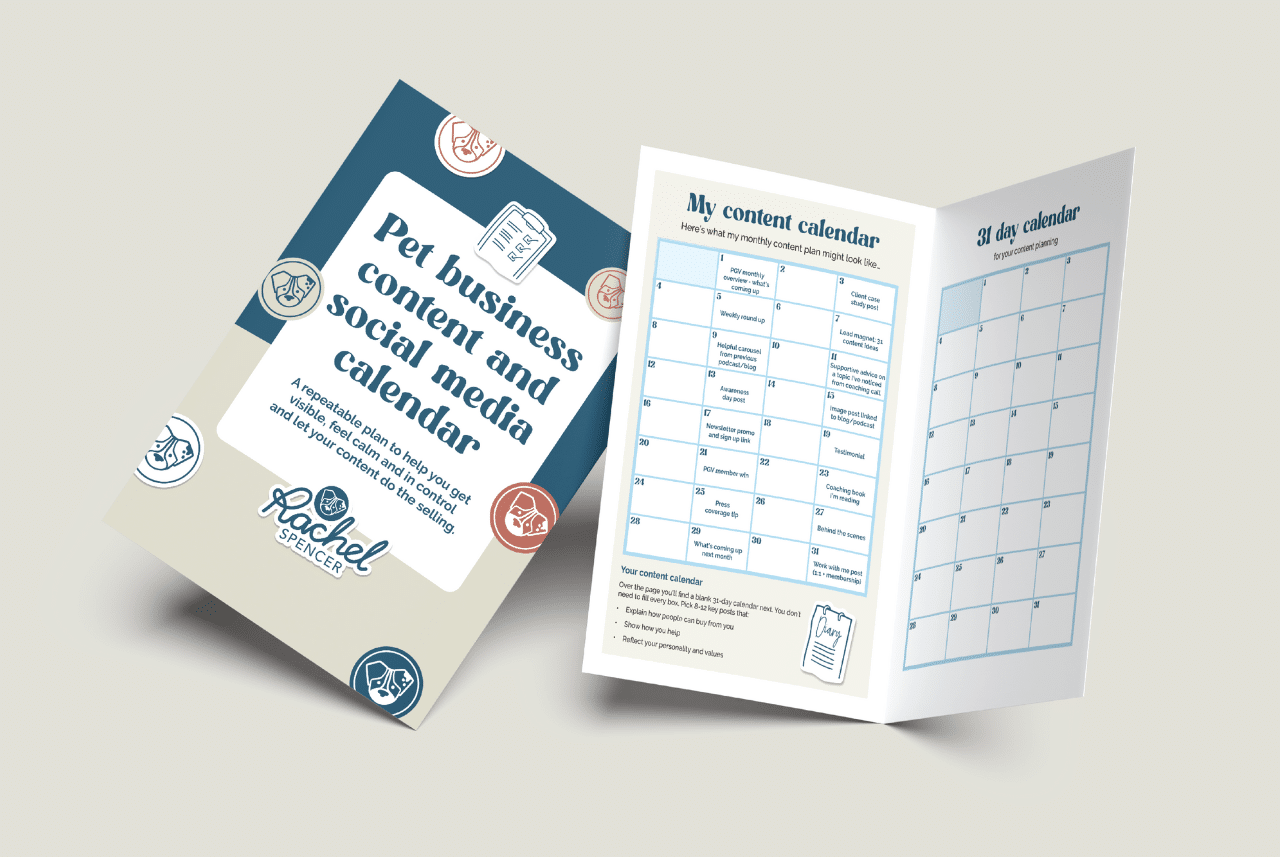
How the Pet Business Content Planner can help
I’ve included coaching exercises for moments when you might want to take some time to think about what you need in the 2026 planner.
You’ll find them in the Words for When section at the front.
They are:
- Comparisonitis check-in – for when you’re spiralling from too much scrolling.
- The project planner – to help you plan out your ideas.
- Energy check-in – to hel you work with your capacity, not against it.
These are exercises for you to do using evidence-based coaching tools.
Head here to buy your planner: https://rachelspencer.co.uk/product/pet-business-content-planner/
Deciding what success looks like for you
When I started this business, my version of success was earning £1,000 a month so I could take pressure off freelancing. Over time, I built up to £2k, £3k, £4k and beyond.
But it took time and guidance and people who didn’t say, “You need to…”, but asked, “What’s enough for you?”
That’s why I built my Pets Get Visible membership. Not to give everyone the same path to follow because everyone is different.
Instead, it’s designed to support you to build your version of a successful pet business, your way.
So next time someone tells you, “You need to…” take a minute and ask yourself, ‘What do I need right now?’
Coaching inside Pets Get Visible
I run at least one coaching call each month in Pets Get Visible, my membership for pet professionals, and you can come along and bring your questions or challenges.
Or join us and listen and get inspired.
If you’d like to join us, it’s £45 a month for 2026, and you can find out more here.
Further reading
Should you buy the Pet Business Content Planner
Why I am an accredited Pet Business Coach
Is my Pets Get Visible membership right for you?
Different kinds of coaching for different stages in your business